There is a pastry in China dense enough to be sold by weight, priced like jewellery, argued about like football, and eaten once a year in slices the size of a thumb. Welcome to Mid-Autumn Festival, the second biggest date on the Chinese calendar after Lunar New Year, where the moon gets the marketing and the mooncake does the work.
In 2026 the festival falls on Friday 25 September, which means the moon is full, the weekend is long, and the mooncake discourse is already in full swing. This guide covers what the holiday actually is, why the cake matters more than the moon, and, most importantly, the wildly different mooncakes China produces depending on which province you ask.
What Mid-Autumn Festival is (in under 200 words)
Zhongqiu Jie (中秋节) lands on the 15th day of the eighth lunar month, when the moon is supposedly at its roundest and brightest of the year. Round means complete, complete means family reunion, so the whole holiday runs on one idea: get everyone back around the same table, look up, eat.

The mythology is mostly about Chang’e, the woman who drank an immortality elixir and floated off to the moon, leaving her husband and a very confused rabbit behind. The rituals are simpler. Lanterns, osmanthus wine, pomelo, and a lot of sitting outside pretending the city sky is dark enough to see anything.
Then there is the gift economy. Mooncake boxes travel from company to client, from son-in-law to mother-in-law, from you to the neighbour who gave you one first. It is the Chinese cousin of the panettone loop, and yes, re-gifting is an open secret.
Why the mooncake, specifically
The popular story says Ming rebels hid messages inside mooncakes to coordinate an uprising against the Mongols. Historians roll their eyes, but the legend explains the vibe: dense, sealed, made to be cut and shared into wedges rather than eaten alone.
A classic mooncake is a thin pastry shell wrapped around a heavy filling, stamped with a wooden mould so the top carries characters for longevity or the bakery’s name. That is where the agreement ends. Once you cross a provincial border, the mooncake becomes an entirely different object.
The great mooncake atlas of China

Cantonese: the default setting
If you have only met one mooncake, it was probably Cantonese-style (广式). Glossy amber crust, brushed with syrup so it stays soft for days, filled with lotus seed paste and one or two salted duck egg yolks that look like a moon when sliced. Red bean and mixed nuts are the classic alternatives. This is the export version, the one in every Milan supermarket, and the reason most Europeans think mooncakes are sweet.
Five kernel: the villain arc
Five-kernel mooncake (五仁) is the most argued-about food on the Chinese internet. Walnuts, almonds, melon seeds, sesame, peanuts, sometimes candied winter melon and bits of sugared pork fat, all packed into a crumbly, slightly savoury brick. Around 2013 a meme campaign demanded it be “expelled from the mooncake world”, and the backlash created a permanent split: grandparents defend it, millennials mock it, Gen Z has quietly decided it slaps when it is made properly. Try one before you pick a side.

Suzhou-style: the meat one
Travel to Shanghai or Suzhou in September and the queue outside any bakery is not for dessert. Suzhou-style (苏式) mooncakes use a flaky, laminated crust closer to puff pastry, and the local hero is the fresh meat mooncake (鲜肉月饼): seasoned minced pork, juicy, served hot, eaten standing on the pavement. Sweet versions exist, with rose petal or black sesame, but the pork one is the point.
Beijing-style: dry, crunchy, unbothered
Northern China does its own thing. The Beijing-style (京式) 自来红 and 自来白 are smaller, drier, scented with sesame oil and filled with rock sugar crystals and nuts that crunch aggressively. They are less pretty and less rich, and locals like them exactly for that reason.
Chaoshan and Yunnan: the regional flexes
The Chaoshan (潮式) mooncake from eastern Guangdong uses a lard crust so tender it collapses when you look at it, wrapped around mung bean or, if you are lucky, mashed taro paste. Head southwest and Yunnan (滇式) fills its mooncake with cured Xuanwei ham and honey, a sweet and salty combination that sounds like a dare and tastes like a national treasure.

Snow skin and lava custard: Hong Kong’s remix
Hong Kong bakeries reinvented the format twice. First in the 1980s with snow skin mooncakes (冰皮): glutinous rice flour, no oven, served cold, filled with mango, durian, matcha or custard, essentially a mochi that dressed up for the occasion. Then in the 2010s with the molten salted egg custard (流心奶黄) mooncake, a small golden puck that leaks orange lava when you cut it warm. This is the version that goes viral every year, and honestly it deserves it.
The chaos tier
Because it is China, someone always pushes it too far. Recent years have delivered crayfish mooncakes, Sichuan-numbing mala pork mooncakes, ice-cream mooncakes from every Western brand with a Shanghai office, and Palace Museum collector editions priced like handbags. The packaging got so excessive that Beijing passed rules in 2022 capping how many layers of box a mooncake is allowed to hide inside. Progress.
Finding mooncakes in Milan
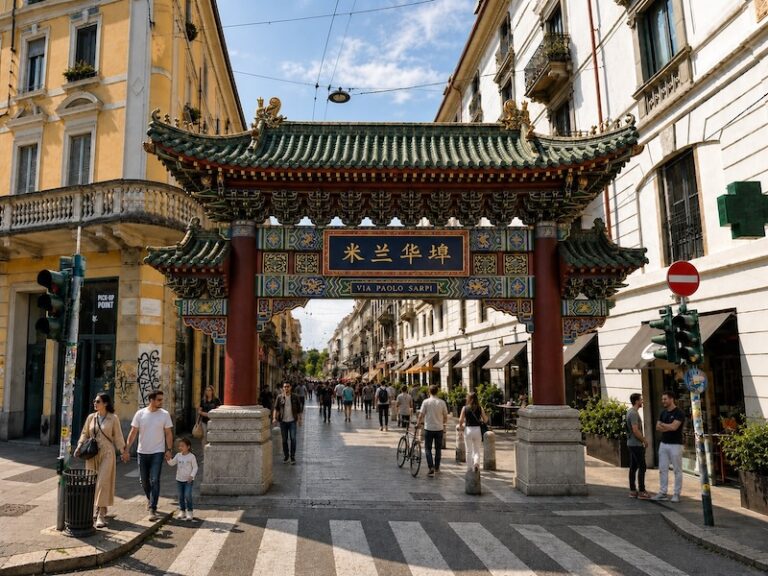
The supermarkets and bakeries along Via Paolo Sarpi and the surrounding streets stock the Cantonese classics from early September, with lava custard boxes appearing closer to the date and disappearing fast. Snow skin needs a fridge, so ask at the counter rather than hunting the shelves. Fresh meat mooncakes are the rare find: if a bakery in Chinatown Milano is doing them hot, that is your Friday plan.
Explore our guide to the best Asian grocery stores in Milan (link here) for mooncake shopping.
Mid-Autumn Festival is a reunion holiday, but the mooncake is where the real cultural map lives. One pastry, a dozen regional identities, and an internet feud that has outlasted most celebrity marriages. Start with a lotus seed and double yolk, graduate to lava custard, and earn your stripes with a five-kernel. Then tell us which side you are on at @chinatownmilano.it.