Tanabata vs Qixi: On July 7, Japan Celebrates a Chinese Love Story. China Waits Until August. Let Us Explain.
Today, July 7, Japan celebrates Tanabata (星祭り, Hoshimatsuri), known as the “Star Festival.” Shopping streets from Tokyo to Kyoto hang thousands of colored paper strips, each one carrying a handwritten wish, tied to bamboo. Yes, it’s that bamboo emoji sitting on your keyboard that you never knew what to do with. 🎋 is not generic bamboo, it is a Tanabata tree. Cute. Very Instagrammable. Also, not originally Japanese.
Tanabata is the Japanese version of Qixi (七夕, meaning “Evening of the Seventh”), a Chinese festival with over 2,000 years of history, built on one of the oldest love stories ever written down. The earliest reference to it appears in the Classic of Poetry, a Chinese anthology compiled more than 2,600 years ago, which means this story was already old when Rome was still arguing about kings. If you have ever wondered why Japan parties on July 7 while China’s “Valentine’s Day” lands on a seemingly random date in August (this year: August 19), the answer involves one legend, two calendars, and a 19th-century Japanese government decision that split a single festival in two.

The original story: a cowherd, a weaver girl, and the worst mother-in-law in the sky
The legend goes like this. Zhinü (织女), the weaver girl, is a goddess who spends her days weaving clouds. She comes down to earth, falls for Niulang (牛郎), a poor cowherd with nothing to his name except a suspiciously talkative ox, and marries him. The Queen Mother of Heaven finds out, loses it, and drags her daughter back to the sky. When Niulang chases after her, the Queen Mother slashes a river of stars across the sky to separate them forever. That river is the Milky Way.
The couple became stars: Zhinü is Vega, Niulang is Altair, and between them runs the galaxy itself. Look up on a clear summer night and the whole drama is right there. The gods eventually showed a shred of mercy: once a year, on the seventh night of the seventh lunar month, magpies fly up and form a bridge across the Milky Way so the two can meet. If it rains that night, tradition says those are the couple’s tears.
One story, one date, one very dramatic sky. So how did it become two festivals?
How the festival got to Japan and lost its calendar
Qixi crossed to Japan around the 8th century, during the Nara period, when Japanese courts were importing Chinese culture wholesale: writing, Buddhism, city planning, festivals. The lovers were renamed Orihime and Hikoboshi, the story merged with a local weaving ritual, and the date stayed exactly where China put it: seventh day, seventh lunar month.
Then came 1873. The Meiji government, in full modernization mode, scrapped the lunisolar calendar and adopted the Gregorian one. Most festivals were simply re-pinned to the same numbers on the new calendar, so “lunar 7/7” became “solar July 7,” roughly a month and a half early. China never made that move for its traditional festivals, which is why Qixi still floats with the lunar calendar and lands anywhere between late July and late August.

Here is the detail we love: some Japanese cities never fully accepted the switch. Sendai, home of the most famous Tanabata celebration in Japan, still holds its festival in early August, deliberately closer to the original Chinese timing.
Same date, different vibes
The two festivals also drifted apart in meaning. Tanabata became a wish-making festival: you write your hope on a tanzaku paper strip, tie it to bamboo, and let the universe handle logistics. Romance is in the backstory but not really the point anymore.
Qixi went the other way. Historically it was called Qiqiao (乞巧), the “begging for skill” festival, a night when young women prayed to Zhinü for talent in weaving and needlework, threaded needles under moonlight, and laid out offerings of fruit and melon seeds. The romance was always there in the legend, but the festival itself belonged to girls and their craft. Only in the last two decades did Chinese marketing rebrand Qixi as “Chinese Valentine’s Day,” and now it runs on flowers, jewelry campaigns, and restaurant bookings, like February 14 with better mythology.
And it is not just China and Japan. Korea celebrates Chilseok on the same lunar date with the same story, where the lovers are known as Gyeonu and Jiknyeo, Korea’s version of the cowherd and weaver girl. In Vietnam it is Thất Tịch, also same lunar date, and Gen Z there has turned eating red bean dessert (chè đậu đỏ) that night into a ritual for finding love. One Chinese legend, four completely different festivals.

How to mark it in Milan
You have two options, which honestly feels on brand for this story.
Celebrate the Japanese way today, July 7: write a wish, find some bamboo (a plant on your balcony counts, we do not judge), and look up. Vega and Altair are genuinely visible from Milan on a clear July night, light pollution permitting, and they are two of the brightest stars in the summer sky.
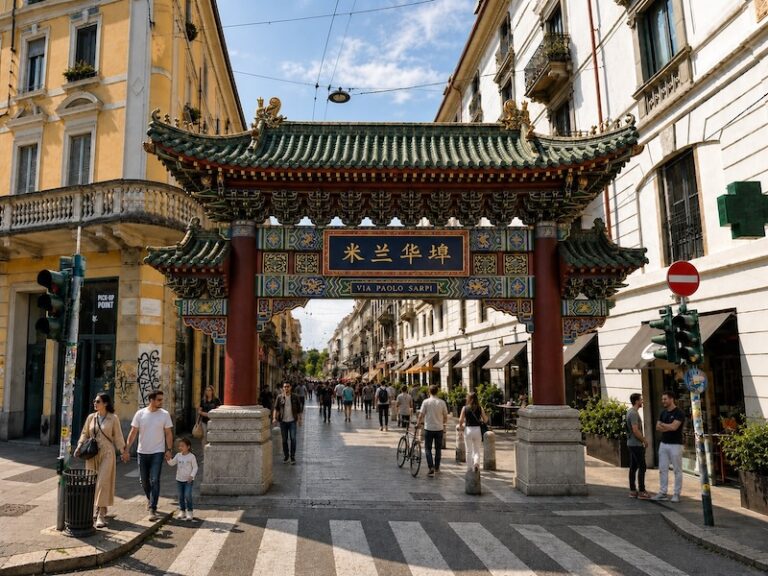
Or hold out for the original. Qixi 2026 falls on Wednesday, August 19. Book a table for two in Paolo Sarpi, order something with red bean in it for the Vietnamese crossover credit, and toast to a couple who have kept a long-distance relationship going for two millennia. If it rains that night, now you know whose tears those are.
Did you learn something new about the Chinese Calendar system? Let us know what you think, and do not forget to bookmark chinatownmilano.it for more Asian culture, food and hidden stories around the city, and follow us on social media @chinatownmilano.it.