Dear Chinatown lovers, we know why you visit: the food, the exotic feel, the pang of homesickness if you have Chinese roots. But no matter who you are, you have to admit that many Chinatowns play an important part in the cities they call home, and some even become part of their city’s soul, so woven in that the place would not be the same without them.
A great Chinatown is never just decoration. It is living proof of a community travelled thousands of kilometers, put down roots in unfamiliar soil, and built somewhere to belong, one dumpling shop and one temple at a time.
So here are nine of the best Chinatowns in the world, loosely ordered by history, importance and sheer staying power. One of them (yes, Dubai) bends the rules completely. And the whole way through, we are quietly asking the question closest to home: how does Milan’s own Via Paolo Sarpi hold up against these giants?

1. San Francisco, USA
The heavyweight. San Francisco’s Chinatown is one of the largest outside Asia and the oldest in North America, with roots reaching back to the mid-19th century, still going strong across roughly 24 blocks. Walk through the Dragon Gate, get lost on Grant Avenue, and time your visit for one of the best-known Lunar New Year parades outside Asia.
And that iconic pagoda-roof look? It was a survival strategy. In the early 1900s, San Francisco sought Chinatown’s valuable downtown land amid widespread anti-Chinese discrimination. The community responded by rebuilding in an ornate style, turning the neighborhood into a landmark too valuable to displace. Vox’s Missing Chapter tells that story better than we can in The surprising reason behind Chinatown’s aesthetic.

2. Bangkok (Yaowarat), Thailand
If San Francisco is the history lesson, Yaowarat is the fever dream. Bangkok’s Chinese community was resettled around Sampheng in 1782, and Yaowarat Road itself was cut through in the 1890s. Today it is a nightly ritual of neon, gold shops and street food (it’s also the one in cover photo): stir-fried crab, boat noodles, mango sticky rice, eaten standing on a plastic stool.
It is also home to some of the cheapest Michelin-recognised food on earth: a handful of Yaowarat stalls carry the Michelin Guide’s Bib Gourmand seal while charging under 150 baht (around €4) a plate, and a legendary bowl of peppery guay jub noodle soup can run barely more than a euro.
Bonus Italian trivia: Cesare Cremonini shot the video for “La nuova stella di Broadway” in Bangkok, not New York. A song named after Broadway, filmed in Thailand, because the obvious choice would have been too obvious.

3. Manila (Binondo), Philippines
The record holder: the world’s oldest Chinatown in the world. Binondo was established in 1594 by the Spanish colonial authorities as a settlement for Chinese immigrants, many of them Catholic converts, on a patch of land just across the Pasig River from the walled city of Intramuros. More than four centuries later it is still a working commercial district and the beating heart of Filipino-Chinese (Tsinoy) life, from centuries-old churches to gold traders and herbal medicine shops.
Come for the history, stay for the food: flaky hopia, fresh lumpia, dumplings by the dozen, and old family restaurants turning out a Cantonese-Filipino cooking you will not taste anywhere else. One of the most delicious ways to get pleasantly lost on foot.

4. New York (Manhattan), USA
Dense, loud and cinematic, Manhattan’s Chinatown is one of the most filmed Chinese neighborhoods on earth. It sits in Lower Manhattan, just a few blocks from Wall Street and the towers of the Financial District, with Broadway running along its western edge, which makes the contrast almost surreal: hand-pulled noodle shops, herbal pharmacies and steaming dumpling windows in the shadow of global finance.
As one of the oldest and most storied Chinese enclaves in the Western Hemisphere, it has been a first stop for generations of new arrivals and remains a cultural and commercial anchor for the whole city, not just a neighborhood but part of New York’s identity, though rising rents and gentrification are a real part of its present. And it is far from New York’s only Chinese community: Flushing in Queens, plus Sunset Park and Bensonhurst in Brooklyn, are huge parts of the modern story.

5. London (Soho), UK
Small but mighty. Centred on Gerrard Street in the West End, right in the theatre district, London’s Chinatown packs roast-duck windows, dim sum parlours, bakeries and bubble-tea queues into a few pedestrianised lanes marked by ornate paifang gates.
It grew from post-war Cantonese migration, much of it from Hong Kong, and it throws one of the best-known Lunar New Year celebrations outside Asia. The Soho version is younger than you might think, forming in the 1950s; London’s earlier Chinatown grew up decades before in the East End docks of Limehouse, until wartime bombing and redevelopment scattered it.

6. Lima (Barrio Chino), Peru
The wildcard we will defend forever. Lima has one of the oldest and most influential Chinese communities in Latin America, rooted in the waves of Cantonese laborers who arrived from the mid-1800s.
Its Barrio Chino centers on Calle Capón, entered through a red-and-gold Chinese arch gifted by the community, and it gave the world chifa, Chinese-Peruvian cooking so beloved it became part of the national table, with chifa restaurants now in practically every Peruvian town. The influence runs even deeper than the dedicated spots: lomo saltado, a Peruvian classic, carries a clear Chinese hand in its wok technique and soy. Culture-mixing done right.

7. Melbourne, Australia
The overachiever of the Southern Hemisphere. Running through the heart of the CBD along Little Bourke Street, Melbourne’s Chinatown is the longest continuous Chinese settlement in the Western world, dating to the 1850s gold rush, when Chinese miners called Victoria “New Gold Mountain” (San Francisco was the older one).
Today the strip runs the full spectrum from old-school Cantonese yum cha to fiery Sichuan, hotpot and northern Chinese cooking, spilling into narrow heritage laneways. Its Chinese Museum is also home to the world’s largest Chinese processional dragon, which tells you how seriously this city takes Lunar New Year.

8. Singapore (Kreta Ayer)
Here is the twist that sets Singapore apart: this is a Chinatown in a country that is itself about three-quarters ethnic Chinese, so it works less as an enclave in a foreign land and more as a heritage quarter, a preserved reminder of where the community began. Its borders were first drawn by the British in Raffles’ 1822 town plan, which zoned the young colony by ethnicity and set aside this stretch for Chinese immigrants arriving from Fujian and Guangdong.
The Chinatown Complex is Singapore’s largest hawker centre, with hundreds of stalls, and it is where a plate from a formerly Michelin-starred soya-sauce-chicken stall can cost less than your airport coffee. Budget food, serious flavor. It is also a snapshot of the island’s mix: the grand Buddha Tooth Relic Temple and the Hokkien Thian Hock Keng sit near Sri Mariamman, the country’s oldest Hindu temple, all within a few blocks.

9. Dubai Mall Chinatown, UAE
And now for the deliberate exception. Dubai’s “Chinatown” is not a neighbourhood at all, but a themed indoor precinct inside Dubai Mall that opened in early 2023, on Level 1 near the ice rink. Think giant panda statues, Kowloon-style neon, a Chinese-medicine spa and a food hall stacked with heavy hitters like Haidilao and a Dubai outpost of Hawker Chan. It is a product of booming China-UAE ties and a huge local appetite for Chinese food, not of an immigrant community putting down roots.
For the closer-to-real version, Dubai already had Dragon Mart, a vast dragon-shaped wholesale complex of Chinese traders out in International City. But as a slick, air-conditioned love letter to Chinese food culture in 45-degree heat, the mall version absolutely does its job. We gave it the full treatment in its own piece as the opener to our Chinatowns of the World series, Chinatown at Dubai Mall, with more destinations on the way.
The verdict and where does Milan fit in?
For history, Binondo takes it. For sheer scale and fame, San Francisco. For pure eating, it is a genuine toss-up between Bangkok and Singapore, and we would happily lose that argument on repeat.
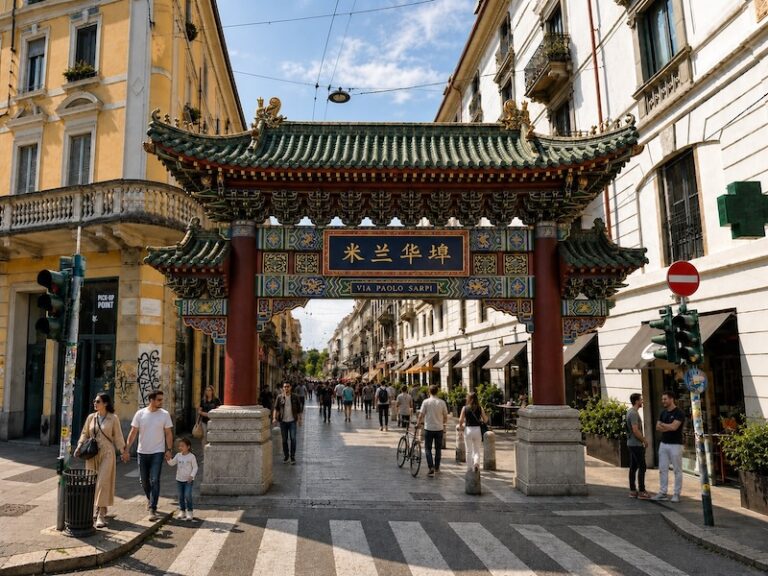
Milan’s Chinatown around Via Paolo Sarpi does not play the same game as the gold-rush giants. Its early migrants came from Zhejiang province, mostly around Wenzhou, who built the community on textiles, leather and wholesale trade. It is smaller than the global icons. But it might be the most effortlessly integrated place on this list, where Chinese and Milanese daily life actually overlap instead of performing for tourists.
The series does not stop here, check out our cultural articles including the World’ Best Chinatown series. Tell us which Chinatown we should walk you through next at @chinatownmilano.it, and if Sarpi is home for you too, we will see you on the street!